Saturday, February 9, 2013

Schimbare domeniu

In urma sugestiei lui Bogdan (multumesc!) de pe Laura si Apollo prin lumea larga, anunt si aici mutarea blogului pe domenul propriu: http://travelinghawk.me  Multumesc tuturor celor care ma urmaresc.

I want to announce the moving of my blog to a new domain: http//travelinghawk.me  Thank you to all my readers!

Thursday, December 13, 2012

Pe Drumul Matasii in Uzbekistan 25. Madrese in oglinda: Ulugbek si Abdulazizkhan / On the Silk Road in Uzbekistan 25. Mirrored Maddrasah: Ulugbek and Abduazizkhan


The two madrasah I will present today have been built at a distance of aprox. 200 years. The first one was erected by Ulugbek, the grandson of Amir Timur (Tamerlane), on 1417. It was the first madrasah constructed by him, and the only surviving monument from the Timurides time. It is an example of good proportions and excellent design.


The second madrassah was constructed by the order of Abdulazizkhan, on 1651/52. Because he lost his throne in the same year, de decoration remained unfinished but still one can see the richness of decoration here. It is a luxuous building, influenced by Chinese architecture. This is the last construction of this size in Bukhara.


Sistemul kosh de a construi madrase  "in oglinda", pentru a le potenta valoarea arhitectonica si artistica, este caracteristic Buharei. Asa este si cazul celor doua madrase pe care vi le prezint astazi, construite la distanta de 200 de ani una de alta.

Tuesday, December 11, 2012

Pe Drumul Matasii in Uzbekistan 24. Madrasa Nadir Divan-begi si un spectacol de exceptie / On the Silk Road in Uzbekistan 24. Nadir Divan-begi Madrasah and an Exceptional Show


“Divan-begi” or “vizier” designates the second in command, after the Khan. Nadir Divan-begi was a rich merchant of Turkmen origin who built a caravanserai in the old center of Bukhara. At the inauguration ceremony, Quli Khan declared it a madrasah, so Nadir Divan-begi had to add the loggias and the gate with the two towers, cut at the level of the gate.


The portal has a nice decoration, presenting two simourghs (phoenix bird), two white deers, and a sun with a human face. These are uncharacteristic motifs for Islamic monuments but a new trend has been set some years before in Samarkand and Nadir just followed.


It is this building were they organize shows for the tourists, including folk music and dances and also fashion shows. The fashion parade, presenting dresses inspired by the folk art let me with the image of some huge, beautiful  butterflies I let you to judge by yourselves.


“Divan-begi” sau “vizir” este o functie care desemna in Buhara pe primul om in hanat, dupa han.
In 1622/23, Nadir Divan-begi din Bukhara, vizirul Hanului Quli, a construit un caravanserai, langa rezervorul de apa din Lyabi Khauz. La inaugurare insa, hanul l-a laudat pentru frumoasa constructie inchinata lui Allah si a proclamat-o medresa. Nadir a fost astfel obligat sa schimbe destinatia initiala a constructiei si sa ii adauge logiile din fata si turnurile de la intrare, taiate la nivelul portii.

Sunday, December 9, 2012

Pe Drumul Matasii in Uzbekistan 23. Madrasa Chor Minor si Complexul Bolo-khauz / On the Silk Road in Uzbekistan 23. The Chor Minor Maddrasah and the Bolo-khauz Complex


Chor Minor (meaning “Four Minarets”) is an interesting monument in Bukhara. It was built in 1807, as indicated on an inscription near the entrance. In fact, it is believed to be the remnants of a lost madrasah, constructe din 1589. This part, which we see today, was the entrance gate into madrasah, a building with four towers. These ones, in spite o their name never served as minarets, having  mainly a decorative role, with their blue domes. Three of them served as dwellings and into the fourth a small and narrow stair led to the second level, to the library. If you climb this stair nothing spectacular would be revealed.


Chor Minor was built by a rich merchant of Turkmen origin, called Niyazkul. The legend says that he had four daughters whom he couldn’t marry. So he widespred the rumor that each minaret represents one of his daughter and so, due to the beauty and fame of the minarets, each girl found a good husband very soon.


Inside the building, a big chamber served as mosque but now it is a souvenir shop. In the area, few pretty schoolgirls, wearing uniforms with fine embroyderies, cheered up the hot atmosphere determined by the Uzbek sun.


Very near the Ark Fortress, the Bolo-khauz (meaning “childrens”pool”) drew our attention. There, the Bibi Khanoum (Old Queen) Mosque, constructed by the mother of Abdul Fayed Khan’s, presents us with the beauty of its famous ayvan, with nicely decorated ceiling. Some craftsmen are selling there their products.


The almost white interior is sober. The floor is covered by praying carpets. The short minaret outside is more recently built: 1917, by the famous local craftsman Shirin Muradov.


Pe niste stradute inguste si fara trotuar, cu case cu acoperisuri aproape plate si geamuri putine, am ajuns la Chor Minor, un monument interesant al Buharei. Desi numele sau, care inseamna “Patru minarete” te duce cu gandul la o moschee, se pare ca aceasta constructie este ceea ce a ramas dintr-o madrasa si a indeplinit rol de poarta de intrare, cu patru turnuri. Madrasa a fost construita in 1807 de catre Califul Niyazkul, un negustor bogat de origine turcmena, dupa cum indica o inscriptie de langa intrare. Altii afirma ca medresa pierduta ar fi fost construita in 1589.

Friday, December 7, 2012

Pe Drumul Matasii in Uzbekistan 22. Chasma Ayub si Moscheea Magoki Attori / On the Silk Road in Uzbekistan 22. Chasma Ayub and Magoki Attori Mosque

Near the Mausoleum of Ismail Samani, Chasma Ayub reminds us of the Job’s well from the Bible (Jobis Ayub in Arabic). This construction has been renewed more times, last time in the 16th century. The conic dome is unusual for Bukhara, and comes from the 12th century. There is a Museum of Water Supplies inside.


Not far from our hotel, the Magoki Attori Mosque is one of the oldest monument in Bukhara. It was constructed in the place of a pagan temple, dedicated to Siun, the god of the moon. This one stayed on the place were once a market for idols, medicines and herbs (“attori”means “herb”) was. It is believed that Jews worshiped together with Muslims in this mosque. The name of “magok” means “in the pit”, because the mosques is under the soil level. The portal is a masterpiece representative for the

Islamic architecture, and it was added in the 16th century. A Museum of the Carpet has been open inside, on 1991.


We also visited a local ceramic workshop, which runs in the family for six generations. 


In apropierea Mausoleului lui Ismail Samani se afla Chasma Ayub, constructie legata de biblicul Iov (Ayub in araba), care a batut in pamant cu bastonul sau si a descoprit un izvor cu apa buna de baut. Ea a fost refacuta de mai multe ori, forma de astazi – caracterizata printr-un dom conic, neobisnuit pentru zona Buharei – datand din secolul al 16-lea. Izvorul de apa tamaduitoare, gasit de Iov, se afla si astazi in interiorul care gazduieste in prezent un Muzeu al Resurselor de Apa.

Wednesday, December 5, 2012

Pe Drumul Matasii in Uzbekistan 21. Istorie, strazi si piete in Buhara / On the Silk Road in Uzbekistan 21. History, Streets and Markets in Bukhara


Bukhara, one of the oldest town in Central Asia, has nowadays 250000 inhabitants. Its long and impressive history it’s a long row of events, dynasties, and religion changing. The archeological drenches went in depth to  a 20 m horizon, to reveal the remnants of the town.

Certain historical sources fix the beginning in the 13th century B.C., almost 1000 years before the Alexander the Great! Aryans migration, Iranian Soghdian ruling, being part of the Persian Empire, Arabs conquest, Genghis Khan invasion, Russian protectorate, being part of the former Soviet Union is a very short synopsis of Bukhara’s history. The name of the place is o Soghdian origin, claim some historian, “Buxarah” meaning “lucky place’. Others sustain that the name comes from the Sanskrit “Vihara”, meaning “monastery” and sustaining the Budhist past of the time.

During the conversion to Islamism (after the conquest of the Arabs, in the 8th century), Bukhara became a world renowned center of science and education. Over 350 mosques and 100 maddrasah determine dthe nickname od “Noble Bukhara”.


Around 500 B.C., when the actual town was constructed, the God Sin was worshiped here, the God of the Moon, who protects the nomads people. The town developed to 350 B.C., when it was captured by the Hua Mongolian tribes, who brought upon it the decline.


As every traditional plain town, Bukhara had also an ark – a fortress where local rulers lived -, the shakhristan, which was the town itself, and a necropolis, outside town limits, with the crypts asnd tombs. Two main crossroads streets parted the town in four sectors, representing the universal order in society and nature. From that time, 140 historic and archeological monuments remained.


The Ark looked into the old Registan square of which only a minaret remained. The Ark had powerful, impressive walls and four gates (only two can be seen today). The site was in reconstruction, so we could only see one gate and the walls, from outside.


The trade domes, which are very near, where the place were the traders gathered. It is a dome covered area, were you may see now the souvenir vendors. Walking after the locals, we saw also the modern market.


Buhara, unul dintre cele mai vechi orase ale Asiei Centrale, numara astazi 250000 locuitori si se afla la vest de Samarkand. Istoria sa multimilenara este bogata in evenimente, siruri de dinastii, schimbari de religie. Orasul a crescut pe verticala timp de peste 2500 de ani dar nu si-a schimbat niciodata locul. Santurile sapaturilor arheologice au mers pana la 20 m adancime pentru a revela urme ale asezarilor anterioare.

Sunday, December 2, 2012

Pe Drumul Matasii in Uzbekistan 20. Mausoleul Samanizilor / On the Silk Road in Uzbekistan 20. Mausoleum of Samani Dynasty

On our first morning in Bukhara we visited the mausoleum of the Samani dynasty. In the middle of a park, it seems that the construction is floating among the trees and flowers. It reminded me on some constructions I have seen in India.

The mausoleum has been constructed at the end of the 9th century and the beginning of the 10th. Ismail Samani, the founder of the last Persian dynasty in Central Asia, constructed the mausoleum for his father, in spite of the Islamic interdiction to erect a construction over a tomb. He only took the example of a caliph from Baghdad. The mausoleum became in time a family crypt, were his father, he himself and his grandson Nasra are burried.


This is the oldest intact monument in Bukhara. The locals covered it with sand to protect it during Genghis Khan’s invasion. It is also the first mausoleum constructed in Central Asia.


To put a hemi-spheric dome on a cube, without inside columns, means very precise mathematical calculations. But this was not a problem for Bukhara, a world center for science by that time!

Using only baked bricks, beautiful patterns have been created out of vertical and horizontal lines but also using disks and rosettes. All in one, the monument is a masterpiece which mirrors his eternity in a little pond beside.

In prima dimineata la Bukhara, primul obiectiv vizitat a fost – nu intamplator – mausoleul dinastiei Samanizilor. Aflat in parcul cu acelasi nume, mica constructie de o perfectiune neasteptata, pare ca pluteste intre arbori si flori. De indata ce am privit-o mai indeaproape, mi-a amintit de multe constructii vazute in India.

Saturday, December 1, 2012

1 Decembrie - La Multi Ani, Romania! / December, 1 - Happy Birthday, Romania!

Tudor Gheorghe is a well known Romanian folk ballad singer, who sings his own compositions. This ballad, entitled "There, Is My Country" is nicely illustrated by images from Romania. I found this the best way to illustrate the moment. Enjoy!


La multi ani, romani!

Friday, November 30, 2012

Pe Drumul Matasii in Uzbekistan 19. Complexul Lyabi-Khauz si cazare la Bukhara / On the Silk Road in Uzbekistan 19. Lyabi-Khauz Complex and Accommodation in Bukhara

We left Khiva at 9 p.m., flying to Bukhara one hour. Our accommodation was at Hotel Asl, right in the centre of old Bukhara, in the Lyabi-Khauz Complex. The complex was built during the 16th and 17th centuries, and it didn’t change much since then. The name means “at the pond or reservoir”, and is given after the pond in the middle of the square. Back in the 1620, when it was constructed, it was the largest artificial reservoir in Bukhara. Now it measures 46mx36m, and it is surrounded by old trees, especially mulberry trees. Their leaves have been used to raise the silkworms. It is presumed that one of the mulberry in the square was planted in 1477!


Using the kosh method, two buildings are constructed in the mirror: the Nodir Divan-Begi meddresah and the khanaka, a shelter for the Sufi pelerins, who visited Bukhara.

There are always many people walking in the park, in the middle of the square. The women wear dresses in traditional colors and patterns, and are very friendly. The children are nicely dressed to be admired by the tourists, who are ever ready to take photographs of them!

Am plecat din Khiva seara, la ora 21, cu o cursa locala de avion. Drumul a durat aproximativ o ora.
Ajunsi la destinatie, ne-am cazat la Hotel Asl, chiar in Complexul Lyabi – Khauz, al doilea ca marime dupa Complexul Registan din Samarkand. 

Lyabi – Khauz dateaza din secolele 16-17 si a ramas aproape neschimbat. Numele inseamna “la bazin” dupa constructia din 1620, care se afla in mijlocul sau. Era cel mai mare rezervor artificial din Bukhara veche. Astazi el masoara doar 46mx36 m si este inconjurat de copaci batrani, mai ales duzi, ale caror frunze se folosesc de mult pentru cresterea viermilor de matase. 
 acest dud a fost plantat in 1477!
                                                                        alt dud batran
Chiar in fata hotelului, de o parte a bazinului, se afla  medresa Nodir Divan-Begi, originar un caravanserai, construit in secolul 17, despre care voi scrie mai tarziu.
 medresa Nodir Divan-Begi
In partea opusa, dincolo de bazin, in ale carui ape se oglindeste, a fost construit khanaka, un adapost pentru pelerinii Sufi care veneau in oras. Metoda aceasta de a construi cladiri pereche, in oglinda, era numita kosh si se intalneste mult in aceasta zona, pentru medrese.
 
khanaka din Lyabi-Khauz
In parc, atrage turistii statuia dedicata lui Nastratin Hogea, cunoscut aici cu numele de Nasruddin Hojas, un Sufi cunoscut pentru umorul sau. Poate unii ati citit in copilarie pildele sale educative. Daca nu, puteti cumpara in Bukhara o mica culegere, in diverse limbi.
 Nastratin Hogea
E mereu lume la plimbare pe aici, asa ca poti observa in liniste tipologia locala. Femeile poarta haine in culori si modele traditionale. Copiii sunt imbracati frumos si lasati sa fie admirati de turisti, care deseori ii si fotografiaza.
Hotelul Asl este construit in stil traditional, avand in fata ayvanul sprijinit pe stalpi. In interior, influentele locale se vad in finisaje. O mica curte interiora este locul unde iti poti bea linistit cafeaua. Seara, poti admira de la fereastra piata frumos iluminata.
 Hotel Asl, Bukhara
 elemente de decor traditionale
 curtea interioara
 panou frumos decorat
Complexul Lyabi-Khauz

Thursday, November 22, 2012

Pe Drumul Matasii in Uzbekistan 18. Palatul Tash Kauli, Khiva / On the Silk Road in Uzbekistan 18. Tash Kauli Palace, Khiva


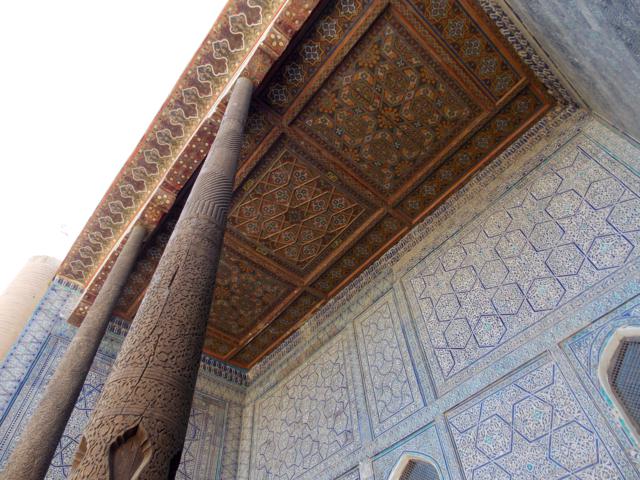
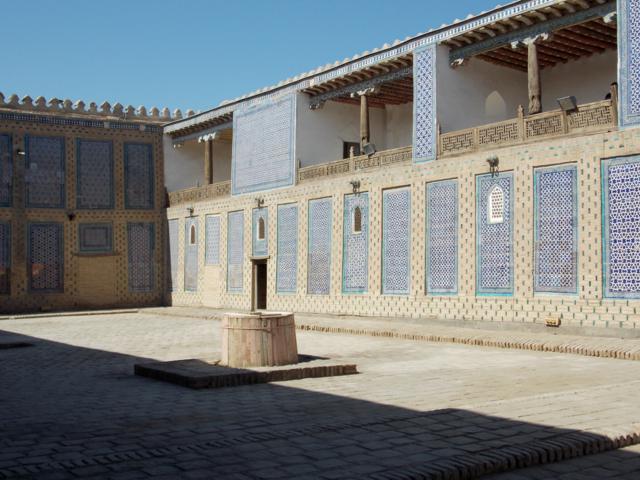
The Tash-Khovli Palace, which is the Khans’ summer residence, was constructed during 1830-1838, by the mighty Allah Kuli Khan. The name means "stone house". It is said that a thousand Persian slaves worked more than 8 years at the construction. A smaller yard, named mikhmankhana, was the ceremony court. In the middle stands sufa, where the yurt (traditional tent) was erected, and were the guests were entertained.

Another court was dedicated to the harem. Each of the four wifes of the Khan had an ayvan. The khan was also living there, and so did his relatives and servants.

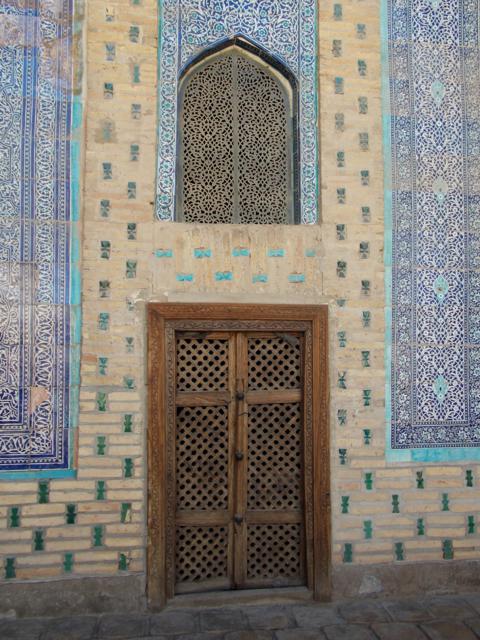
Abdullah “The Genius” was the master of the rich decorations in the palace. Stone and wood, beautifully sculpted, the incredible blue of the majolica, the painted ceilings, all these make of the palace the most outstanding place in Khiva.

Resedinta de vara a hanilor din Khiva a fost construita intre anii 1830-1838 de catre Hanul Allah Kuli. Ea este Palatul Tash-Khovli, utilizat pentru primirea oaspetilor si audiente. Numele palatului se traduce prin "casa de piatra". Un numar de 1000 de sclavi persani au lucrat mai bine de 8 ani la construirea edificiului.
 Tash-Khovli
Intr-o mica curte interioara, patrata, numita mikhmankhana, aveau loc receptiile oficiale.  Musafirii petreceau in iurta (cort traditional) asezata pe un podium mai inalt (numit sufa), din caramida. Nelipsitul ayvan (terasa deschisa, sprijinita pe stalpi) impresioneaza - ca in tot palatul - prin decoratiunile de majolica albastra si tavanul frumos pictat.
 ayvanul in care sedeau oaspetii
 tavanul din lemn pictat
 sufa pentru iurta
Constructia s-a realizat in etape, la decorarea palatului participand cei mai buni mesteri ai vremii. Haremul era partea in care isi avea resedinta si hanul. O curte interioara, de forma dreptunghiulara, este marginita de constructia cu un etaj, cu patru ayvane mici, cate unul pentru fiecare dintre cele patru sotii ale hanului. Ultimul, cel mai bogat decorat, apartinea hanului. Tot aici locuiau si rudele acestuia si servitorii.

Hanul Allah Kuli a condus Khiva intr-o perioada plina de succes. Comertul profitabil cu Rusia tarista a produs suficiente castiguri pentru ca ridicarea unui asemenea edificiu sa fie posibila. Decorarea palatului se datoreaza, in mare masura, lui Abdullah "Geniul", care si-a dobandit porecla tocmai datorita artei sale. Lucratura in piatra si lemn, tavanele pictate, albastrul peretilor placati cu faianta, toate fac din Palatul Tash-Khovli un loc care iese in evidenta in Khiva.