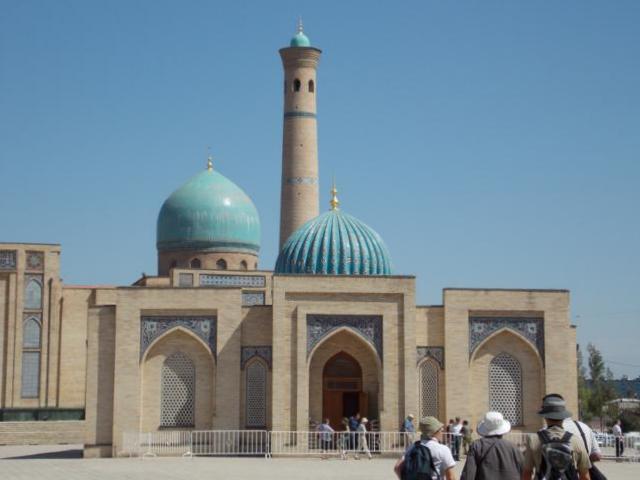
In the part of the city were it is supposed
to be the old centre – Shashi - , a complex of monuments called Khast Imam
Complex wes erected in few centuries. The complex was built around the burial
place of the first imam (Islamic leader), Khaffal ash-Shashi. Born in 903 in
Tashkent, he was educated in Samarkand, Bukhara and Termez. He visited Damascus
and Baghdad and than Mecca, twice. Khaffal was one of the founder of sharia,
the moral and relious code of Islam. He was proclaimed saint after his death,
and a mausoleum was erected over his tomb in 1541. It was designed as khanaka,
meaning shelter for the travelers. On the 12 m heigh façade, an Arabic
inscription ask all the visitors to pray for him.
Near the mausoleum, another building
is the former Namazgokh mosque, now the site of a renowned Islamic university, Imam
al-Bukhariy, founded in 1970. After finishing their studies in a madrasah,
young people come here to study for four years: religion, history, literature
and Arabic.
In the 19th. century the
Juma Mosque or Friday Mosque has been built. It has two minarets, 56 m tall. On
the opposite side, the buildings of the Tilla Sheikh Mosque, are now a famous
library with thousands of manuscripts beautifully written and richly adorned.
Among them, the Othman’s/Osman’s Koran, the most famous Koran in the world. It
was hand-copied in 651 by Othman, one of the Mohammad’s collaborators, who
became the 3rd. Caliph after Mohammad’s death. It is said he was
attacked by non-believers while he copied the Koran and his blood is still on
the pages. This precious book traveled a lot, and after reaching Russia, he was
sent back to Uzbekistan in 1924, from political reasons. It is forbidden to
take photos of the skin pages, written with very big letters, a real art work.
The last visited building here was the
Barak Khan Madrasah, 16th. century, which has now a lot of little
souvenir shops. It still has a little mosque, and the beauty of the painted
walls could still be admired.
Acolo unde in vechime ar fi fost, se crede, centrul orasului numit Shash, s-a ridicat in cateva secole un ansamblu de monumente - scapate de urgia cutremurului - ansamblu numit Khast Imam. El s-a format in jurul mormantului primului
imam (lider islamic) al Tashkentului si propavaduitor al islamului, Kaffal ash-Shashi. In acelasi timp, Kaffal a fost si un mare poet. Acesta s-a nascut in anul 903 si, dupa ce si-a desarvarsit educatia in madrasele din Samarkand, Bukhara si Termez, a fost considerat urmasul spiritual al celor doi stalpi ai teologiei musulmane, Imam al-Bukhariy si Muhammad at-Termiziy. In cursul vietii sale a vizitat Damascul si Bagdadul si a facut de doua ori pelerinajul la Mecca sfanta. In lumea araba era numit "Marele Imam" datorita autoritatii sale. A facut totul pentru a raspandi islamismul si a pune bazele
shariei (cod moral si religios al islamului). Dupa moarte a fost proclamat sfant si in 1541 a fost construit un mausoleu deasupra mormantului sau. Acesta are forma unui
khanaka, adica adapost pentru calatori. Iesit din comun este faptul ca fatada - inalta de 12 m - nu este orientata in directia Meccai, ci spre nord. O inscriptie araba deasupra intrarii cere tuturor celor care vin aici, sa se roage pentru el.
Mausoleul Khaffal-Shashi, 1541
cenotaful lui Khaffal
mausoleul din profil, cu frumosul dom albastru
In acelasi complex trecem si pe langa alte monumente pe care insa nu le vizitam. Abia am timp sa fac cate o fotografie ici-colo. Acesta este unul dintre dezavantajele excursiei in grup: ea are obiective fixe, alese dupa anumite criterii si un timp alocat vizitarii fiecarui obiectiv. Cand iti organizezi singur excursia, stai cat doresti si vezi ce poftesti!
In fosta moschee Namazgokh datand din secolul al XIX-lea, langa mausoleu, isi are sediul Institutul Islamic Imam al-Bukhariy infiintat in 1970 si devenit o prestigioasa institutie de invatamant superior a lumii islamice. Dupa ce termina studiile intr-o madrasa, tinerii vin aici si studiaza, timp de 4 ani, teologie, istorie, literatura si limba araba.
Institutul Islamic Imam al-Bukhariy
Moscheea Juma (Moscheea de Vineri) este construita in secolul al XIX-lea si ofera servicii religioase doar in zilele de vineri. Tot aici se savarsesc si ceremonii de casatorie. Una dintre intrari este strajuita de doua minarete, inalte de 56 m.
Moscheea Juma, sec. XIX
doamna a fost si in Japonia (nu sunt eu) :)


Vis-a-vis de moschee se afla cladirile bibliotecii, care adapostesc manuscrise rare din secolul al XVI-lea, bogat ilustrate si splendid caligrafiate, precum si exemplare frumoase din Coran, daruite de lideri din tari islamice. Cea mai pretioasa comoara insa, adapostita la Tilla Sheikh Masjid ("masjid" inseamna "moschee"), este Coranul lui Othman/Osman - cel mai vestit Coran din lume -, copiat de mana in anul 651, pe 353 de foi de pergament. Califul Othman a fost unul dintre insotitorii Profetului Mohammad, devenit al treilea calif dupa moartea acestuia. Deoarece califul a fost atacat in timp ce copia Coranul, sangele sau se mai afla pe foile acestuia, dand o noua valoare cartii. De-a lungul istoriei sale indelungate, Coranul acesta a calatorit in multe tari, ajungand si in Rusia, de unde a fost restituit tarii sale de origine in 1924. Pe langa valoarea sa istorica si artistica, el are o mare valoare spirituala, credinciosii venind si astazi in numar mare pentru a vedea aceasta carte sfanta. Fotografiatul este strict interzis in interior dar o copie a acestuia ati vazut la postarea despre Muzeul Timurizilor.

Tilla Sheikh Masjid, sec. XIX
Prin piata larga care adaposteste complexul, credinciosii trec cuminti de la o cladire la alta, pentru a se inchina peste tot.
Ultima cladire pe care am vizitat-o in cadrul complexului a fost Barak-Khan Madrasah, o cladire din secolul al XVI-lea, ridicata de nepotul lui Ulugbek, Suyunij Khan. Ea mai are inca o moschee functionala dar, in cea mai mare parta a fost transformata in mici pravalii de suveniruri. Acest lucru nu a diminuat insa cu nimic frumusetea peretilor pictati.
Barak-Khan Madrasah, sec.XVI
dincolo de poarta
femei iesind de la moschee
detaliu stalp din ayvan